HOUSES ON DRY-STONE WALLS
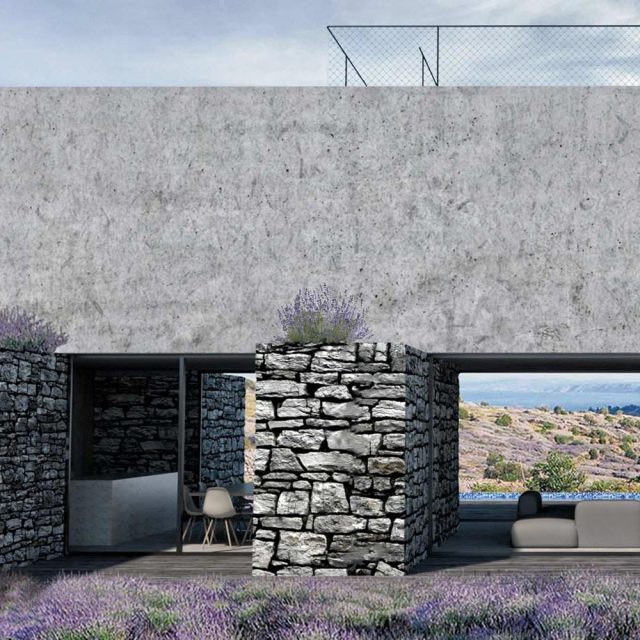
Houses on Dry-Stone Walls arises from a deep respect for heritage, landscape, and the Mediterranean spirit of the place. The dry-stone wall, crafted by the hands of ancestors and a lasting symbol of local identity, becomes the fundamental spatial and conceptual backbone of the project. Indeed, it is not merely an artifact, but an active architectural element that defines space and protects residential intimacy.
A Landscape of Terraces Above Jelsa
The houses sit in the landscape with views towards the Mediterranean nature and the town of Jelsa. The architects carefully integrated them into the partially existing terraced terrain. The project comprises the first family house and a second house intended for rural and luxury tourism, so it establishes a dialogue between private life and contemporary, sustainable tourism.
The Dry-Stone Wall as the Architectural Protagonist
The dry-stone wall plays a central role in spatial organization, since it shields the houses from views and wind and defines the boundaries of privacy. At the same time, it retains its original function of shaping the terraced terrain and cultivating the olive groves. Within its structure, a recessed, intimate courtyard extends the living room and provides natural shading, thanks to the volume of the “bridge” house.
A Bridge Between Stone and Contemporary Form
The architects positioned the architectural volume to create the impression of a bridge between the two sides of the dry-stone wall and the terraced landscape. The upper floor of the house hovers above the stone structures, which emphasises the contrast between the monolithic stone and the contemporary, refined architectural form. As a result, the house achieves an exceptional sense of lightness and levitation, despite its strong anchoring to the ground.
A Dynamic Interplay of Private and Public Spaces
The basement sits fully embedded into the terrain, so it minimises the visual impact on the surroundings while it accommodates service spaces, a winery, storage, and a pool machine room. Meanwhile, the ground floor stays entirely glazed and opens towards two contrasting zones, the intimate dry-stone courtyard and the open terraced yard with a pool and expansive landscape views. The upper floor forms the most exposed and monolithic volume. Bedrooms have controlled openings for increased privacy, while recessed loggias frame views with care.
A Staircase Between Interior and Exterior
A particular emphasis falls on an unusual internal-external staircase, which connects the loggia to the rooftop terrace. This element highlights transparency between interior and exterior and lets the experience of space unfold through vertical movement, culminating in the rooftop terrace with panoramic views. Instead of dominating nature, the houses blend with it, respecting the topography, materiality, and inherited identity of the place. In this way, they become a contemporary interpretation of tradition and identity in the Mediterranean landscape.
HOUSE 1
location:
Rural area Svirče, Island Hvar, Croatia
size:
330 sqm house + 30 sqm covered entrance with parking space + 40 sqm pool
plot:
1 505 sqm
year:
2017
program:
Semi-buried vacation house with swimming pool and covered entrance with parking space
archaos team:
Srđan Ostojić, Toni Kerum, Krešimir Ćavar
HOUSE 2
location:
Rural area Svirče, Island Hvar, Croatia
size:
310 sqm house + 25 sqm covered entrance with parking space + pool 40 sqm pool
plot:
1 505 sqm
year:
2017
program:
Semi-buried vacation house with swimming pool and covered entrance with parking space
archaos team:
Srđan Ostojić, Toni Kerum, Krešimir Ćavar